
 English
 Pусский
 العربية
 Tiếng Việt
Alimentador de placas estacionario de alta resistencia
A stationary heavy-duty plate feeder is a robust material handling machine designed to receive, control, and transfer large volumes of bulk material in demanding industrial environments. It is commonly used in mining, quarrying, cement production, metallurgy, and other heavy industries where reliable feeding of abrasive, coarse, or high-impact materials is required. Built for continuous operation, this type of feeder plays a critical role in ensuring stable and efficient downstream processing.The structure of a stationary heavy-duty plate feeder is typically composed of a solid frame, a chain-driven or track-style conveying system, a series of overlapping metal plates, a drive unit, and supporting rollers or guides. The feeder is installed in a fixed position, usually beneath hoppers, silos, or stockpiles, where it can accept material directly and regulate the discharge flow. Its strong mechanical construction allows it to handle large lumps, heavy loads, and materials with sharp edges or high moisture content.One of the main advantages of this equipment is its exceptional durability. The plate surfaces are often made from wear-resistant steel to withstand impact and abrasion over long periods of use. The moving plates form a continuous conveying surface that can carry material smoothly without excessive spillage. Compared with lighter feeding equipment, a heavy-duty plate feeder performs better when dealing with coarse ore, limestone, clinker, slag, or other difficult materials. It is especially valuable in situations where a consistent feed rate is essential for protecting crushers, screens, or conveyor systems from overload.Another important feature is precise control of material flow. The feeder can be adjusted to match production requirements, helping operators maintain a stable process and reduce surges or interruptions. This controlled feeding improves equipment efficiency, reduces energy waste, and helps downstream machinery operate under more uniform conditions. In large processing plants, maintaining a steady feed is often necessary to maximize productivity and avoid costly downtime.Stationary heavy-duty plate feeders are also known for their high load-bearing capacity. They are engineered to support very heavy materials without deformation or vibration problems. Reinforced components, heavy-duty bearings, and powerful drive systems contribute to reliable performance in harsh working conditions. Because the feeder is stationary, it provides strong installation stability and can be integrated into fixed process lines with minimal movement or alignment issues.Maintenance is another important aspect of this machine. Although it is built for tough service, regular inspection of the plates, chains, drive components, and wear parts is necessary to ensure long-term reliability. Many designs allow for easier replacement of damaged sections, which helps reduce maintenance time and operating costs. Proper lubrication, tension adjustment, and monitoring of wear are essential for safe and efficient operation.In modern industrial plants, a stationary heavy-duty plate feeder is an indispensable piece of equipment. Its combination of strength, stability, and controlled feeding makes it suitable for some of the most challenging bulk handling applications. By delivering material evenly and reliably, it supports the efficiency and safety of the entire production system.
Producto
Categoría:
-
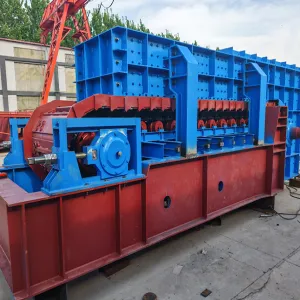
Alimentador de placas estacionario de alta resistencia
Su clasificación: Equipo de alimentaciónVistas: 131Número:Tiempo de liberación: 2026-07-06 14:43:15El alimentador de placas estacionario de alta resistencia es una pieza fundamental del equipo en la industria de manipulación de materiales a granel y representa la configuración clásica y más reconocida de esta maquinaria esencial. A diferencia de sus homólogos montados o móviles, el alimentador de placas estacionario está diseñado para una instalación permanente en una ubicación fija dentro de una planta de procesamiento. Está atornillado a una base de hormigón específica o a un sistema de soporte de acero estructural, convirtiéndose en un elemento permanente de la línea de producción. Esta...
Noticias
Categoría:
¡Sin resultados de búsqueda!
Caso
Categoría:
¡Sin resultados de búsqueda!
Video
Categoría:
¡Sin resultados de búsqueda!
Descargar
Categoría:
¡Sin resultados de búsqueda!
Reclutamiento
Categoría:
¡Sin resultados de búsqueda!
Productos recomendados
¡Sin resultados de búsqueda!



 Whatsapp
 Teléfono